2 Week Morocco Itinerary
Short Overview
If you’re planning two weeks in Morocco, this itinerary was designed for exactly that: fourteen days that move through the country at a pace that lets you actually feel it rather than just see it.
A 2-week Morocco itinerary for people who want depth over distance. The journey covers five distinct worlds: the blue mountain village of Chefchaouen, the ancient imperial cities of Fes and Marrakech, the golden silence of the Sahara desert, the dramatic gorges and kasbahs of the south, and the windswept Atlantic coast of Essaouira. Slow mornings, long lunches, evenings with nowhere else to be. This is what 14 days in Morocco should feel like.
We’ve built two nights into most destinations so you never feel the pressure of a single day. This 2-week Morocco itinerary is private, fully flexible, and shaped around the two of you from beginning to end.
Why Choose Our Journey?
With Berber Hospitality, your journey is private and designed around you. You travel with your own people, your own vehicle, and a local team who can adjust the day as you go. If you want to spend longer exploring a medina, stop for tea in a village, take a quieter morning after the desert, or simply enjoy a beautiful view for a little longer, we can make it happen.
This itinerary is a starting point, not something set in stone. If you’d like more time in the Sahara, a slower few days in Marrakech, an extra night in the Atlas Mountains, or time on the Atlantic coast, we’ll adjust the journey around you. Tell us what you’d like to see, how you like to travel, and we’ll shape the rest together.
Tour Highlights
- Explore Casablanca and visit the Hassan II Mosque.
- Walk through the blue streets of Chefchaouen.
- Discover the ancient Roman ruins of Volubilis.
- Explore Fes’s old medina with a local guide.
- Travel through the Middle Atlas cedar forests.
- Visit Aguelmame Sidi Ali and enjoy the quiet mountain scenery.
- Travel through the Ziz Valley and its palm-filled oasis.
- Discover the fossils and local craftsmanship of Erfoud.
- Experience Merzouga and the golden dunes of Erg Chebbi.
- Ride camels into the Sahara at sunset.
- Spend a night in a luxury desert camp.
- Meet a local nomadic family and learn about desert life.
- Enjoy traditional music and Moroccan hospitality in the desert.
- Explore Todra Gorge and the Dades Valley.
- Travel through the Road of a Thousand Kasbahs.
- Visit the historic Aït Ben Haddou Kasbah.
- Cross the High Atlas Mountains through Tizi n’Tichka.
- Discover the souks and medina of Marrakech.
- Spend a relaxed day on the Atlantic coast in Essaouira.
- Travel privately with a trusted local team and a comfortable vehicle.
Details:
- Duration: 13 Days / 11 Nights
- Group Type: Private Experience
- Availability: Daily
- Start: Casablanca or Tangier
- End: Flexible - Casablanca or Marrakech..
What’s Included
- Private comfortable, air-conditioned vehicle throughout the journey.
- Experienced local driver who knows the roads and regions well.
- Airport pickup in and transfer at the end of the tour.
- 13 nights of carefully selected accommodation.
- Luxury desert camp in Merzouga with a private tent and private bathroom.
- Daily breakfast.
- 3 Dinner meals in Merzouga and Dades Valley.
- Traditional lunch during the Sahara experience.
- Camel trekking in the Erg Chebbi dunes at sunset.
- Sandboarding in the desert.
- Visit to a local nomadic family.
- Local guides for Fes and Marrakech.
- Flexible private travel, with the possibility of adjusting the pace when needed.
- Local assistance before and during your journey
Detailed Itinerary
Your two weeks in Morocco begin the moment you land. We meet you at Mohammed V Airport and transfer you to your hotel.
If you land with enough afternoon light, the Hassan II Mosque is the first experience worth seeking out. Built directly on the Atlantic, it is one of the largest mosques in the world and one of the very few in Morocco open to non-Muslim visitors. The carved cedarwood ceilings, hand-laid zellige tilework, and the sound of the ocean filtering through the walls create an atmosphere that is genuinely hard to leave.
Overnight: Boutique hotel in Casablanca
The first full day of your 14-day Morocco itinerary heads north with a stop in Rabat, Morocco’s capital. The Hassan Tower; a 12th-century unfinished minaret rising from a wide esplanade of ancient columns, and the Mausoleum of Mohammed V, with its carved ceilings and ceremonial guards, are two of the country’s most quietly moving monuments.
From Rabat, the road climbs into the Rif Mountains, the landscape turning green and cool. Chefchaouen appears with its blue medina nestled into a natural bowl between two peaks. Check into your riad, step outside, and wander without a plan. The late afternoon light on the blue walls is one of the most beautiful things in Morocco.
Overnight: Riad in Chefchaouen
Driving time: Around 5 hours
One of the great advantages of a 2-week Morocco itinerary over a shorter trip is that you can give places like Chefchaouen a full day rather than a rushed half-morning.
No driving today! The medina rewards slow exploration: the lanes around the central plaza, the quieter residential quarters, the local souk on weekends, a long coffee at a rooftop café watching the town at its own pace. The walk to the Spanish Mosque above the medina takes 25 minutes and delivers views over the entire blue city that are best seen in late afternoon, when the light turns everything gold.
Overnight: Riad in Chefchaouen
Leaving the Rif, we stop at Volubilis, Morocco’s finest Roman archaeological site, where 1,800-year-old mosaic floors remain vivid and intact among standing columns and triumphal arches. A local guide transforms the ruins from ancient stones into a city you can almost hear.
A brief stop in Meknes to stand before the monumental Bab Mansour gate, one of the most impressive pieces of Islamic architecture in North Africa, before continuing south to Fes, arriving at your riad in the heart of the medina as the evening call to prayer drifts across the rooftops.
Overnight: Traditional riad in Fes
Driving time: Around 4 hours
For anyone planning 14 days in Morocco, Fes deserves a full day and a good local guide. Rushing through it is one of the most common mistakes on shorter itineraries.
Fes el-Bali: the largest car-free urban area in the world and the best-preserved medieval Islamic city on earth, moves through the day’s route in layers rather than monuments. The residential lanes where daily life continues undisturbed. The covered souk streets where the same crafts have occupied the same positions for centuries. The Quaraouiyine University, founded in 859 AD. The elaborately carved Bou Inania Madrasa. The Chouara Tannery, the great circular vats of natural dye that are among the most iconic images in Morocco.
Overnight: Traditional riad in Fes
The long drive south is one of the defining days of any two-week Morocco itinerary, the journey that takes you from the ancient city through the mountains and down to the edge of the Sahara, the landscape changing completely four or five times along the way.
The road climbs through the cedar forests of the Middle Atlas, where Barbary macaques appear in the trees. The forest gives way to the dramatic Ziz Valley, a long corridor of vivid green palm groves running through bare desert rock, before the final stretch to Merzouga, where the Erg Chebbi dunes appear on the horizon like something that shouldn’t exist.
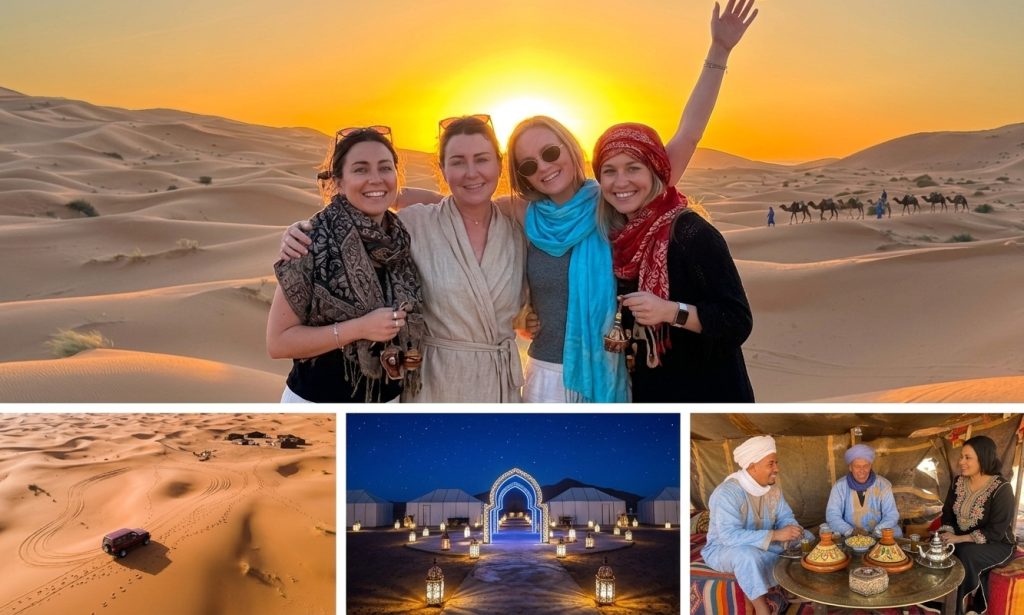
In the late afternoon, your camel guide leads you into the dunes for the sunset trek to your private desert camp. The sand shifts from gold to copper to deep amber as the light drops. Dinner is freshly prepared. Berber music plays around the fire. The desert sky above Merzouga, far from any city light, is one of the finest things your two weeks in Morocco will show you.
Overnight: Luxury Private Desert Camp
Driving time: Around 7 hours
Camel trek: Around 1–1.5 hours
Wake before sunrise and climb the nearest high dune together. The desert at dawn; cold, silent, the stars still bright, then the slow burning of the eastern horizon, is the moment this entire Morocco 2-week itinerary has been building toward.
After breakfast, a 4x4 excursion takes you deep into the Erg Chebbi, enclosed dune bowls of perfect silence, high ridgelines with views across the entire sand sea. Sandboarding on the high dunes. A visit to a local Berber nomadic family for mint tea, genuine conversation, and a traditional homemade lunch. The afternoon will be entirely yours: rest, swim, watch the light change on the dunes. Another extraordinary sunset. Another Saharan night.
Overnight: Boutique Riad in Merzouga
Meals included: Breakfast, Traditional Lunch & Dinner
West from the desert through rocky plains and scattered oases until Todra Gorge appears: 300-metre red-rock cliffs narrowing to 10 metres at the base, a shallow river running cold and clear through the canyon floor. One of the most dramatic natural settings in Morocco and one of the most romantic places to simply stand together for a while.
The drive through the Dades Valley follows, canyon walls in pink and ochre, mud-brick villages merging into the rock behind them, the famous Monkey Fingers rock formations twisting skyward in the afternoon light. Dinner included at your riad, the mountains quiet outside.
Overnight: Riad or boutique hotel in Dades Valley
Driving time: Around 4 hours
Meals included: Breakfast & Dinner
West through the Road of a Thousand Kasbahs, then to Aït Ben Haddou; the UNESCO-listed earthen ksar where Gladiator, Game of Thrones, and Lawrence of Arabia were filmed, and where families have lived within the same mud-brick walls for centuries. Walk through it slowly, climb to the highest point for the view across the valley, take your time.
Then head into the High Atlas Mountains via the Tizi n’Tichka pass at 2,260 metres, the highest road crossing in Morocco, before descending to Marrakech, the city appearing as a pale pink sprawl across a wide plain with the Atlas still visible behind you.
Overnight: Riad in Marrakech
Driving time: Around 6 hours
Two days in Marrakech is one of the clearest reasons to choose a 2-week Morocco itinerary over something shorter. The city cannot be done in a day (not properly).
Your local guide takes you through the medina without rushing. The Bahia Palace — room after room of carved cedarwood ceilings and hand-laid zellige floors, the finest craftsmen of the 19th century given time to produce their best work. The Saadian Tombs, their gilded muqarnas and Italian marble columns discovered sealed behind a wall in 1917. The Koutoubia Mosque and its 12th-century minaret at dusk, when the light on the stone turns amber, and the call to prayer carries across the city.
The afternoon is for the souks. The evening is for Jemaa El Fna, watch the square transform from a rooftop terrace, then go down into it.
Overnight: Riad in Marrakech
The slower Marrakech, the parts the first day didn’t reach, and the unhurried pleasures that the city saves for people who aren’t rushing.
The Mellah, the old Jewish quarter, with its balconied Andalusian-influenced houses and quiet synagogues. The Majorelle Garden, with its famous cobalt blue pavilion surrounded by bamboo and cacti, bequeathed to a foundation by Yves Saint Laurent. The afternoon is for a traditional hammam, steam, kessa scrub, soap massage, mint tea, one of the experiences that belongs on a honeymoon in Morocco and that no 14-day Morocco itinerary should omit.
Evening in Jemaa El Fna, dinner at a restaurant of your choosing, the last night in the medina.
Overnight: Riad in Marrakech
Three hours across the Haouz plain and through the argan forest, where goats genuinely climb the trees to eat the nuts, it's one of Morocco’s small and reliable delights, and the Atlantic coast appears.
Essaouira is a different Morocco from everything that’s come before: white walls instead of pink, ocean wind instead of desert heat, the creative ease of a coastal town that has attracted artists, musicians, and wanderers for decades. Check in, drop your bags, and go immediately to the ramparts, the 18th-century sea wall where old brass cannons still face the Atlantic and the view back over the white medina and blue fishing boats in the harbour is one of the finest in the country.
Walk the port, eat fresh grilled fish at a quayside stall, watch the cats. Dinner by the sea.
Overnight: Riad or boutique hotel in Essaouira
Driving time: Around 3 hours
The final full day of your two weeks in Morocco, and deliberately slow.
A morning walk on the long Atlantic beach, followed by coffee and fresh msemen at a café on the way back. The afternoon for the thuya wood workshops, craftsmen working with a fragrant local wood found nowhere outside Morocco, and the small galleries through the medina where Essaouira’s tradition of local artists produces work that is genuinely interesting and often affordable. The Gnawa musicians who play in the squares are connected to centuries of West African spiritual tradition; sit, listen, and let the last afternoon settle around you.
The best dinner of the trip tonight: a table overlooking the ramparts, fresh Atlantic fish, the sound of the ocean below.
Overnight: Riad or boutique hotel in Essaouira
A slow final morning. Breakfast without rushing. One last walk on the ramparts. Whatever remains undone, done now.
When your flight requires it, we drive to Casablanca or Marrakech with stops wherever something warrants them. We arrive at the airport in good time and stay until you’re through the gates.
Your 14 days in Morocco end here: two weeks of blue cities and golden deserts, ancient medinas and Atlantic wind, desert stars and riad courtyards and the warmth of a country that treats hospitality not as a service but as a value. We hope you carry it with you for a long time.
Tour ends: Casablanca Airport or Marrakech
faqs
Most Travelers Ask About
Two weeks is the ideal length for a first journey through Morocco. A well-planned 2-week Morocco itinerary covers the imperial cities, the Sahara, the mountain villages, and the Atlantic coast without feeling rushed at any of them. It’s the minimum we’d recommend for anyone who wants to experience the country rather than simply pass through it.
The classic 14-day Morocco itinerary runs from Casablanca north to Chefchaouen, south through Fes and the Middle Atlas to the Sahara, west through the valleys and kasbahs to Marrakech, and out to the Atlantic coast at Essaouira. This route covers Morocco’s five most distinct landscapes and cultures in a logical, comfortable sequence.
For two people: a private Toyota Prado 4x4, air-conditioned, comfortable, and driven by your experienced local driver for all 14 days. Just the two of you throughout.
Always. If you want to linger somewhere longer, skip a stop, or take a slower morning, we adapt. Your two-week Morocco itinerary is a starting point, not a fixed programme.
March to May and September to November offer the most comfortable temperatures across all regions covered. Winter is beautiful in the south and on the coast but cold in Chefchaouen and the mountains. July and August are very hot in the desert.
Of course. A private 4x4 transfer to the desert camp is always available at no extra charge.
Get in touch with your preferred dates. We confirm availability, send a full proposal, and hold your dates with a deposit. Confirmation is received at the time of booking.